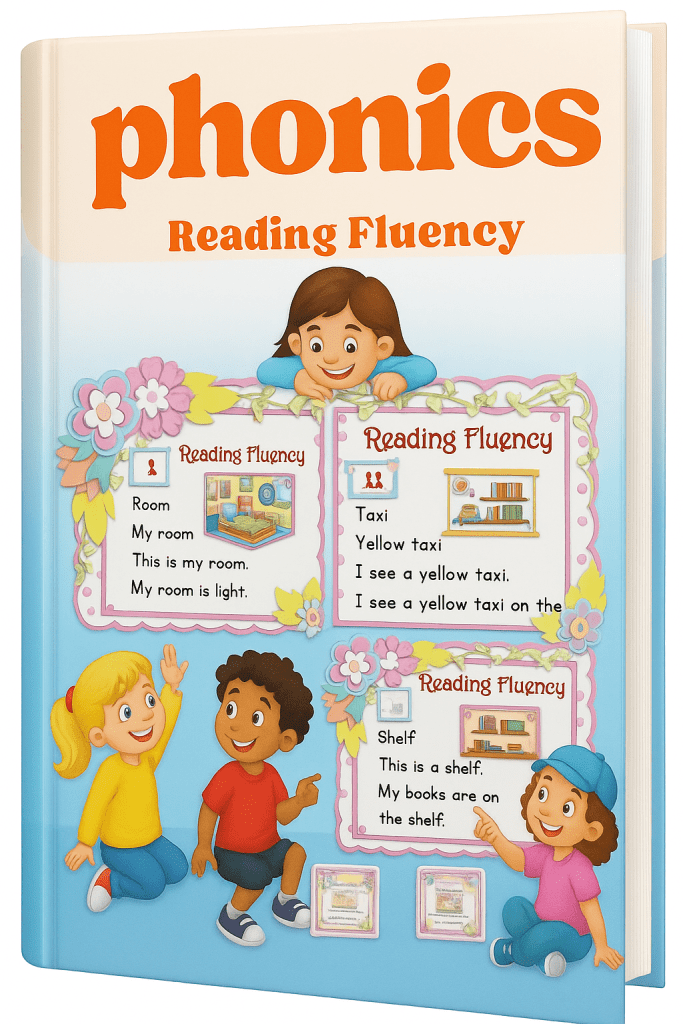
Phonics READING FLUENCY helps young readers move from sounding out words to reading smoothly. Fluency means reading at a natural speed, with expression, and understanding what the words say while you read them.
Use Phonics READING FLUENCY with short repeated readings: the same passage two or three times until it flows. The book is a free PDF on Google Drive, linked from the button below. Its companion is Phonics Book 2nd Reading Fluency Fun.
About Phonics Reading Fluency
Phonics Reading Fluency is a reading book devoted to fluency — the smooth, accurate, expressive reading that comes after decoding is learned. Passages and exercises help children read phonics patterns at natural speed, with understanding.
Many children can sound out any word yet still read like a telegram: word. by. word. Phonics Reading Fluency exists to close that gap, turning careful decoding into flowing reading.
Use Phonics Reading Fluency for daily timed and repeated reading practice, in class fluency slots or at home. The download is linked from the button on this page.
Fluency is not reading fast; it is reading so automatically that the mind is free to understand. Phonics Reading Fluency trains that automaticity on phonics patterns children already know.
Repeated Reading, Real Gains
The book’s core method is rereading: short passages read again until they flow, with each rereading measurably smoother. Phonics Reading Fluency packages this proven method in passages children actually enjoy, so the repetition feels like mastery instead of punishment.
Phrasing and Expression
Beyond speed, the exercises teach reading in phrases with expression — pausing at punctuation, lifting at questions. A child reading expressively from Phonics Reading Fluency is a child who understands, and comprehension is the entire point.
Phonics Reading Fluency in the Classroom Week
Teachers slot Phonics Reading Fluency into the week as warm-up work: five fluent minutes before the main lesson, every day. Within a month the class’s reading aloud changes character — halting becomes flowing, and flowing becomes listening pleasure.
CopyrightsIf this website has shared your copyrighted book or your personal information.
Contact us at [email protected]
to let us know. You will receive an answer within 3 working days.
A big thank you for your understanding